Orchestrate the Entire SDLC — The Final Integration
By the end of this page, you will understand how to connect all 17 persona agents into a unified SDLC pipeline — from PRD validation to production deployment in 2 days.
The Final Orchestration — The 2-Minute Overview
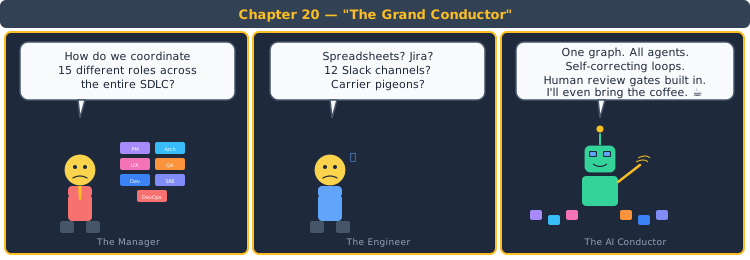
Think about the last time you watched an orchestra perform. 60+ musicians, each playing a different instrument, each following a different part of the score — yet producing one unified piece of music. You didn't hear 60 solos. You heard a symphony. But somebody had to compose the score, define when each section enters, and conduct the performance in real time. That conductor is the LangGraph Supervisor — and the instruments are AI agents for every SDLC persona.
You Already Know Orchestration — You Just Don't Know It Yet
You've been an orchestrator every time you organized a wedding.
💒 The Wedding Orchestration Analogy
A wedding has 15+ vendors (caterer, photographer, florist, DJ, venue, officiant, planner, etc.), each with their own specialty. The wedding planner doesn't cook, photograph, or DJ — they orchestrate: ensure the caterer is ready when guests arrive, the photographer captures the first dance, the DJ plays the right song, and the officiant starts on time. Without orchestration, each vendor delivers their piece perfectly — but the wedding is chaos.
Step 1 — Plan: Book vendors, define timeline, set dependencies.
🔗 Orchestration Layer: ① PIPELINE DESIGN — Define which agents run when, what inputs they need, and what outputs they produce.
Step 2 — Execute with gates: Ceremony must finish before reception starts. Photographer must be set before first dance.
🔗 Orchestration Layer: ② HUMAN-IN-THE-LOOP GATES — Architect reviews plan before coding. Senior reviews code before DEV. Tests must pass before TEST.
Step 3 — Self-correct: Rain forecast → move ceremony indoors. Caterer late → extend cocktail hour.
🔗 Orchestration Layer: ③ SELF-CORRECTION LOOPS — Agent output fails validation → audit → fix → re-validate.
Step 4 — Final delivery: Guests leave saying "That was perfect." Everything came together seamlessly.
🔗 Orchestration Layer: ④ PRODUCTION DEPLOYMENT — Feature toggles, staging, canary, production. Ship it.
The Complete Mapping
| Wedding | SDLC Orchestration | Phase |
|---|---|---|
| Book vendors, define timeline | Design agent pipeline with dependencies | ① Pipeline |
| Ceremony before reception (gate) | Architect review before coding (gate) | ② Gates |
| Rain → move indoors | Audit → fix → re-validate loop | ③ Self-Correct |
| "That was perfect" — seamless delivery | Feature toggle → staging → production | ④ Ship |
You just learned SDLC orchestration without running a single agent.
The 6 Pillars of SDLC Orchestration
1. From Individual Agents to a Unified Pipeline
Each agent solves one problem well. The pipeline connects them so they solve the whole problem together.
The LangGraph Supervisor chains agent outputs: Product Manager Agent → validates the vision → feeds to Product Owner Agent → generates PRD → feeds to Architect Agent → validates architecture → feeds to Senior Developer Agent → generates Code Plan → and so on. Each agent's output is the next agent's input.
| Agent | Input | Output | Next Agent |
|---|---|---|---|
| Product Manager | Business requirement | Validated vision + roadmap | Product Owner |
| Product Owner | Vision + roadmap | PRD with user stories | UX Designer + Architect |
| Architect | PRD | Architecture + API contracts | Senior Developer |
| Senior Developer | Architecture | Code Plan + Test Plan | Junior Developer |
| Junior Developer | Code Plan | Working code + passing tests | QA Agent |
2. Self-Correction Loops
The loop: Audit → Fix → Re-Validate. This is how agents produce production-quality output.
After each agent produces output, a validation agent audits it against standards. If it fails, the producing agent receives feedback and regenerates. This loop continues until the output passes validation — or escalates to a human.
| Loop Step | What Happens | Exit Condition |
|---|---|---|
| Produce | Agent generates output | Output ready for audit |
| Audit | Validation agent checks against standards | Pass or fail |
| Fix | If fail — agent receives feedback, regenerates | Corrected output |
| Re-Validate | Validation agent re-checks | Pass → move forward; fail → escalate to human |
3. Human-in-the-Loop Review Gates
AI generates. Humans validate. The gates ensure nothing moves forward without human judgment.
Two critical gates: (1) Architect reviews Code Plan and Test Plan before coding begins, (2) Senior Engineer reviews code and tests before DEV deployment. These gates are non-negotiable — they're where human judgment catches what AI misses.
| Gate | Who Reviews | What They Check |
|---|---|---|
| Plan Review | Architect | Code Plan + Test Plan against architecture |
| Code Review | Senior Engineer | Code quality, CLAUDE.md compliance, test coverage |
| Test Review | QA Lead | Test completeness against acceptance criteria |
4. Chaos and Performance as Validation Nodes
The pipeline doesn't end at "tests pass." It ends at "the system survives failure and performs under load."
After functional tests pass, the pipeline runs performance tests (load, stress, concurrency) and chaos tests (DB blackout, latency spike, zombie container). These are validation nodes — if they fail, the pipeline stops and feeds back to the appropriate agent.
| Validation Node | Runs After | Pass Criteria |
|---|---|---|
| Performance Tests | Integration tests pass | SLOs met under expected load |
| Chaos Tests | Performance tests pass | System recovers from injected failures |
5. Release Engineering
Feature toggles, staging, canary, production. The last mile is the most controlled.
The release is not a single deployment — it's a graduated rollout: staging (production mirror) → canary (5% of traffic) → production (100%). Feature toggles control which users see the new feature. If metrics degrade during canary, rollback automatically.
| Release Phase | Traffic | Monitoring | Rollback Trigger |
|---|---|---|---|
| Staging | Internal traffic only | Full monitoring | Any test failure |
| Canary | 5% of production traffic | SLI comparison vs. baseline | Error rate > 2× baseline |
| Production | 100% traffic | Full monitoring + alerting | P0 alert fires |
6. The 2-Day Challenge
Understand, design, build, test, deploy — in 2 days. That's the bar.
Day 1: Run the full pipeline from PRD through architecture. Day 2: Run from code generation through deployment. This is possible because: agents handle the tasks, humans handle the judgment, and the pipeline handles the flow.
| Day | Activities | Output |
|---|---|---|
| Day 1 | Product → PRD → Architecture → Code Plan | Reviewed Code Plan + Test Plan |
| Day 2 | Code generation → Tests → Performance → Chaos → Deploy | Production-ready system |
The Complete Mapping
| # | Pillar | What It Answers | Key Decision |
|---|---|---|---|
| ① | Unified Pipeline | How do agents connect? | Output chaining + dependency management |
| ② | Self-Correction | How do agents improve output? | Audit → Fix → Re-Validate loops |
| ③ | Human Gates | Where do humans intervene? | Plan review, code review, test review |
| ④ | Validation Nodes | Is it reliable and performant? | Performance + chaos tests in pipeline |
| ⑤ | Release Engineering | How does it reach users safely? | Feature toggles, canary, graduated rollout |
| ⑥ | The 2-Day Challenge | Can we do it all in 2 days? | Yes — agents + humans + pipeline |
That's it. The entire SDLC — from idea to production — orchestrated by AI agents and validated by humans.
Try It Yourself — A Starter Prompt for SDLC Orchestration
You are an SDLC Orchestration Architect designing a LangGraph supervisor pipeline.

I need a unified SDLC pipeline for:

{{PASTE YOUR PRODUCT REQUIREMENT}}

Cover these 6 areas:

1. AGENT PIPELINE — List the agents in execution order with inputs and outputs per agent.
2. SELF-CORRECTION — Define the audit → fix → re-validate loop. What standards are checked?
3. HUMAN GATES — Identify the human review gates and who reviews at each.
4. VALIDATION NODES — Where do performance and chaos tests fit in the pipeline?
5. RELEASE STRATEGY — Define the graduated rollout: staging → canary → production.
6. 2-DAY TIMELINE — Map the pipeline to a 2-day execution plan.

For each area, provide: the design and a brief justification.
What This Prompt Covers vs. What It Misses
| Skill | Lite Prompt (Free) | Full Prompt (Course) | Impact of Missing It |
|---|---|---|---|
| Agent execution order | ✅ Covered | ✅ Covered | — |
| Self-correction design | ✅ Covered | ✅ Covered | — |
| LangGraph implementation code | ❌ Missing | ✅ Working LangGraph supervisor with all agents | Pipeline designed but never implemented — theoretical only |
| Agent prompt templates per persona | ❌ Missing | ✅ Production-ready prompts for each of 17 agents | Agents wired up but prompts are generic — poor output quality |
| Error budget integration | ❌ Missing | ✅ "If error budget < 20%, block new deployments" | Pipeline deploys despite SLO violations — reliability degrades |
| Rollback automation | ❌ Missing | ✅ Automated rollback on canary degradation | Canary shows issues, manual rollback takes 15 minutes. Auto-rollback would take 30 seconds. |
| End-to-end observability | ❌ Missing | ✅ Trace a requirement from PRD through to production | "Where's that feature from the PRD?" — lost traceability across agents |
The Lite Prompt gets you to ~60% quality. Good enough to understand orchestration. Not good enough to build a pipeline that ships production systems in 2 days.
Real-World Example: Orchestrating an SDLC Pipeline for a Task Management App
The Requirement
"Orchestrate the full SDLC for a task management app: create tasks, organize into projects, set due dates, track progress. From PRD to production in 2 days."
Lite Prompt Output
① Pipeline: PM Agent → PO Agent → UX Agent → Architect Agent → Senior Dev Agent → Junior Dev Agent → QA Agent → Perf Agent → Chaos Agent → DevOps Agent → SRE Agent.
② Self-Correction: After each agent, validate output against standards. If fail, re-generate.
③ Human Gates: Architect reviews Code Plan. Senior Dev reviews code. QA reviews tests.
④ Validation: Performance tests after integration. Chaos tests after performance.
⑤ Release: Staging → canary (5%) → production (100%). Feature toggle.
⑥ 2-Day Plan: Day 1: PRD through Code Plan. Day 2: Code through production.
What a Principal Architect Would Catch
| Area | Lite Says | What's Missing | Consequence |
|---|---|---|---|
| Pipeline | Linear chain of 11 agents | No parallel execution. UX and Architect can run in parallel after PO. Linear = slower. | Day 1 takes 12 hours instead of 8. Human reviewers are idle waiting for sequential agents. |
| Self-Correction | "Validate against standards, re-generate" | No escalation after 3 retries. What if the agent can't self-correct? | Agent loops forever trying to fix itself. Pipeline stalls. No human notification. |
| Human Gates | "3 review gates" | No review SLA. How long does the Architect have to review before the pipeline stalls? | Architect is in a meeting. Review waits 4 hours. Day 1 plan ruined. |
| Validation | "Performance after integration" | No performance baseline. What are we comparing against? | Performance tests "pass" but there's no before/after comparison. Regression undetected. |
| Release | "Canary 5%" | No canary duration. 5 minutes? 5 hours? | 5-minute canary catches nothing. 5-hour canary would have caught the memory leak that surfaces at hour 3. |
| 2-Day Plan | "Day 1: PRD→Plan. Day 2: Code→Prod" | No contingency if Day 1 goes over. No buffer between days. | Day 1 finishes at 11pm. Day 2 starts at 9am. Team is exhausted. Quality drops. |
The pattern: The Lite Prompt asks "what does the pipeline look like?" The full course asks "what does the pipeline look like, what parallelizes, what stalls, and how do you recover?"
What You Learned Today vs. What the Course Teaches
| Dimension | Free Page | Course Chapter |
|---|---|---|
| Theory & Mental Model | ✅ Complete | ✅ Complete + anti-patterns |
| Real-Life Analogy | ✅ Complete | ✅ Complete |
| Prompt | ⚠️ Lite — ~50% skill coverage | ✅ Full — LangGraph code, agent prompts, rollback automation |
| Example Output | ⚠️ High-level — passes glance test | ✅ Full — passes principal architect review |
| LangGraph Implementation | ❌ Not included | ✅ Working supervisor with all 17 persona agents |
| Agent Prompts | ❌ Not included | ✅ Production-ready prompts per persona |
| Assessment Quiz | ❌ Not included | ✅ 10 questions (scenario + trade-off + synthesis) |
| The 2-Day Challenge | ❌ Not included | ✅ End-to-end project: understand → design → build → test → deploy |
| Skill Verification | ❌ Not included | ✅ Knowledge → Decision → Build → Synthesize |
Ready to Orchestrate the Entire SDLC?
You now understand how all 17 persona agents connect into a unified pipeline — from PRD validation to production deployment. That mental model is real, and it's yours to keep.
But understanding orchestration and building a LangGraph supervisor that ships a production system in 2 days are two different things. The course gives you:
- ✅ A working LangGraph supervisor with all 17 persona agents
- ✅ Production-ready prompts for each persona
- ✅ Self-correction loops with escalation to human review
- ✅ The 2-Day Challenge — build, test, and deploy a real system from scratch
- ✅ Industry readiness — the skills and confidence to deliver freelancing projects with speed and precision
This is the final chapter. You've learned every persona, every phase, every pillar. Now bring it all together — understand, design, build, test, and deploy in 2 days.